

Lincoln and Douglas showed the power of true debate
by Scot Loyd
Every election cycle, people complain that political debates just aren't what they used to be. They're usually right, though perhaps not for the reasons they think. Modern debates often feel less like an exchange of ideas and more like a race to produce the best sound bite. Candidates interrupt each other, dodge questions, and deliver rehearsed lines crafted for social media rather than for thoughtful discussion.
It wasn't always that way.
Most people think of debate through the lens of the Lincoln-Douglas debates of 1858. Even if you've never read a transcript, you've probably heard them described as one of the defining moments in American political history. Abraham Lincoln and Stephen A. Douglas met seven times across Illinois to debate the expansion of slavery. While the immediate prize was a seat in the U.S. Senate, the real audience was the nation itself, wrestling with questions that would eventually lead to the Civil War.
What surprises people today is the format.
Imagine showing up to hear a political candidate speak for an hour. Then imagine the other candidate responding for an hour and a half. Finally, the first speaker gets another thirty minutes to wrap things up. Three hours. Standing outside. Often in the heat. And thousands of people came.
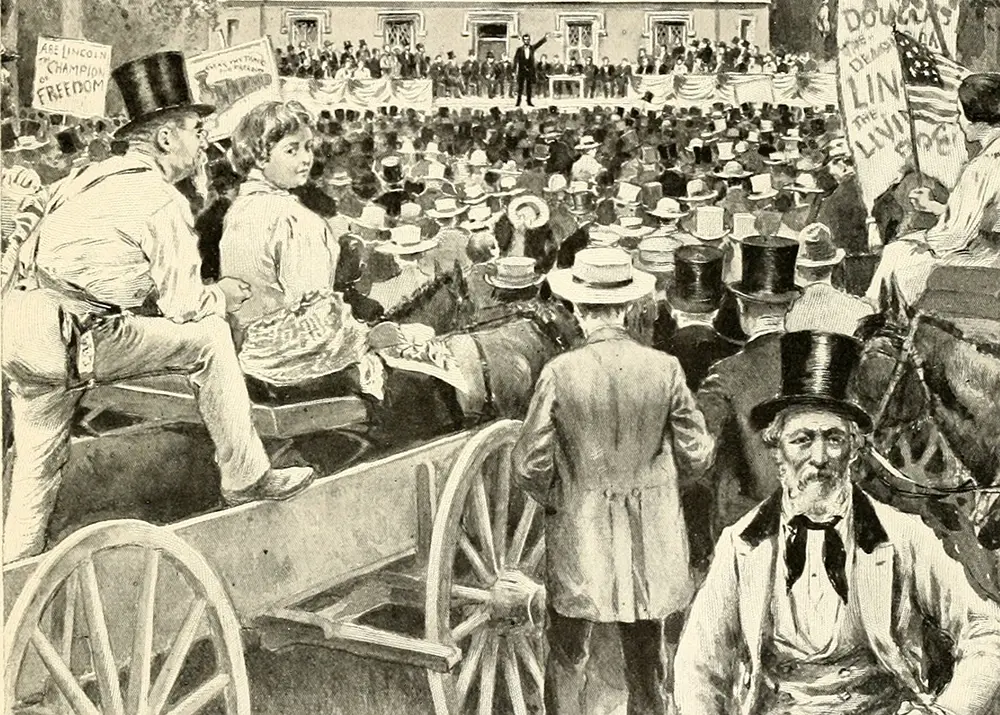 The crowd at the Lincoln-Douglas debate in Galesburg.
That wasn't just because people had longer attention spans than we do today. It was because debate was understood differently. The goal wasn't simply to entertain or energize your supporters. It was to persuade people by making a reasoned argument.
Of course, we shouldn't romanticize those debates too much. Lincoln and Douglas knew how to land an insult, and neither was above entertaining the crowd at his opponent's expense. Lincoln once compared Douglas to the squid-like cuttlefish, which escapes its enemies by releasing a cloud of ink. He was suggesting that Douglas used political rhetoric to obscure his actual positions. On another occasion, Lincoln questioned whether Douglas enjoyed the exclusive privilege of being on every side of every question.
Douglas could give as good as he got. He accused Lincoln of changing his political positions depending on which part of Illinois he happened to be visiting. His accusations also exploited the racial prejudices of his audiences, repeatedly portraying Lincoln as an advocate of racial equality. Lincoln's actual position was more complicated. He opposed the expansion of slavery and believed Black Americans were entitled to the natural rights promised in the Declaration of Independence, but he did not advocate full social or political equality and explicitly supported white political supremacy during the 1858 debates. This distinction is important because, while Lincoln challenged the institution of slavery, he was also a politician navigating the deeply entrenched racial prejudices of his time.
In other words, political debates have always involved a certain amount of theater. The difference wasn't the absence of insults or memorable one-liners. It was that Lincoln and Douglas had to sustain their arguments for hours, address substantive disagreements, and respond to one another in front of audiences who had come to hear considerably more than a clever comeback.
Lincoln and Douglas quoted history, appealed to constitutional principles, responded directly to each other's claims, and trusted that ordinary citizens were capable of following a complicated discussion.
In many ways, they were carrying on a tradition that stretches back more than two thousand years.
The ancient Greeks viewed public argument as one of the essential responsibilities of citizenship. In Athens, debates weren't reserved for politicians. Citizens gathered to discuss laws, justice, war, and public policy. Philosophers like Socrates became famous not because they gave inspiring speeches, but because they asked difficult questions. Rather than telling people what to think, Socrates challenged them to examine what they already believed. Plato preserved many of those conversations, and Aristotle later explained that persuasion wasn't just about emotion. It also depended on logic and credibility.
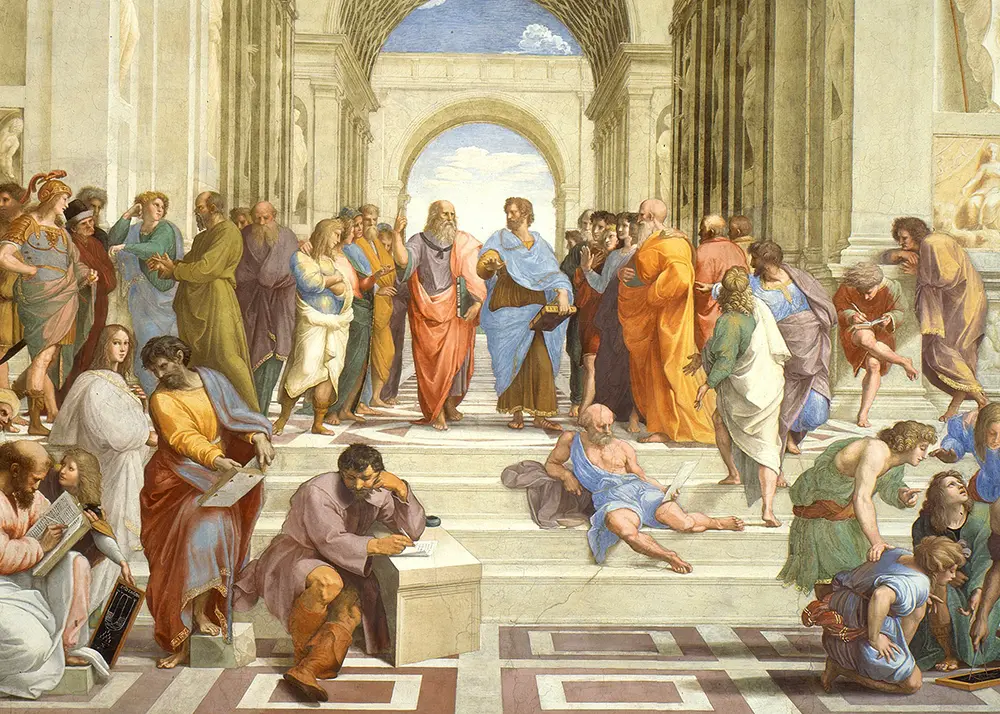 Plato and Aristotle at the center of Rafael’s “The School of Athens”
That approach shaped education for centuries. Medieval universities held formal disputations where students defended ideas before teachers and classmates. Later, debate societies became common on college campuses, training future lawyers, ministers, and public officials. The assumption was simple: if your ideas couldn't survive honest questioning, perhaps they needed to be reconsidered.
Lincoln himself articulated something remarkably similar during his first debate with Douglas at Ottawa. Responding to accusations that he had misrepresented his opponent's position, Lincoln argued that the responsibility of a capable debater was to demonstrate errors through evidence and reasoning rather than simply accuse an opponent of dishonesty. It's a distinction that remains central to the practice of competitive debate today.
Modern competitive debate events are often closer to that tradition than our political debates are.
Many high schools use the "Lincoln-Douglas" debate format. That doesn't mean a literal reenactment of the 1858 debates, nor does it reproduce their three-hour format or particular political controversies. Instead, it adapts the tradition of sustained argument to a structured competition in which students examine philosophical questions, defend their positions, and respond to opposing arguments.
Students might debate whether justice should be valued over equality or whether civil disobedience is morally justified. The goal isn't simply to "win." It's to learn how to build a coherent argument, support it with evidence, anticipate objections, and think critically under pressure.
I've spent nearly twenty years coaching debate, and one of the biggest misconceptions people have is that debate teaches students to argue about everything. In reality, good debate teaches the opposite. It teaches you to listen carefully before responding. It forces you to understand the other side well enough to answer it fairly. It teaches research, intellectual humility, and the ability to separate evidence from opinion. Those are skills that matter far beyond a tournament.
Which brings us back to today.
Television changed debates. Social media accelerated the shift. Attention spans grew shorter, time limits became tighter, and memorable one-liners began carrying more weight than carefully developed arguments. Success is often measured by who "won the clip" rather than who made the better case.
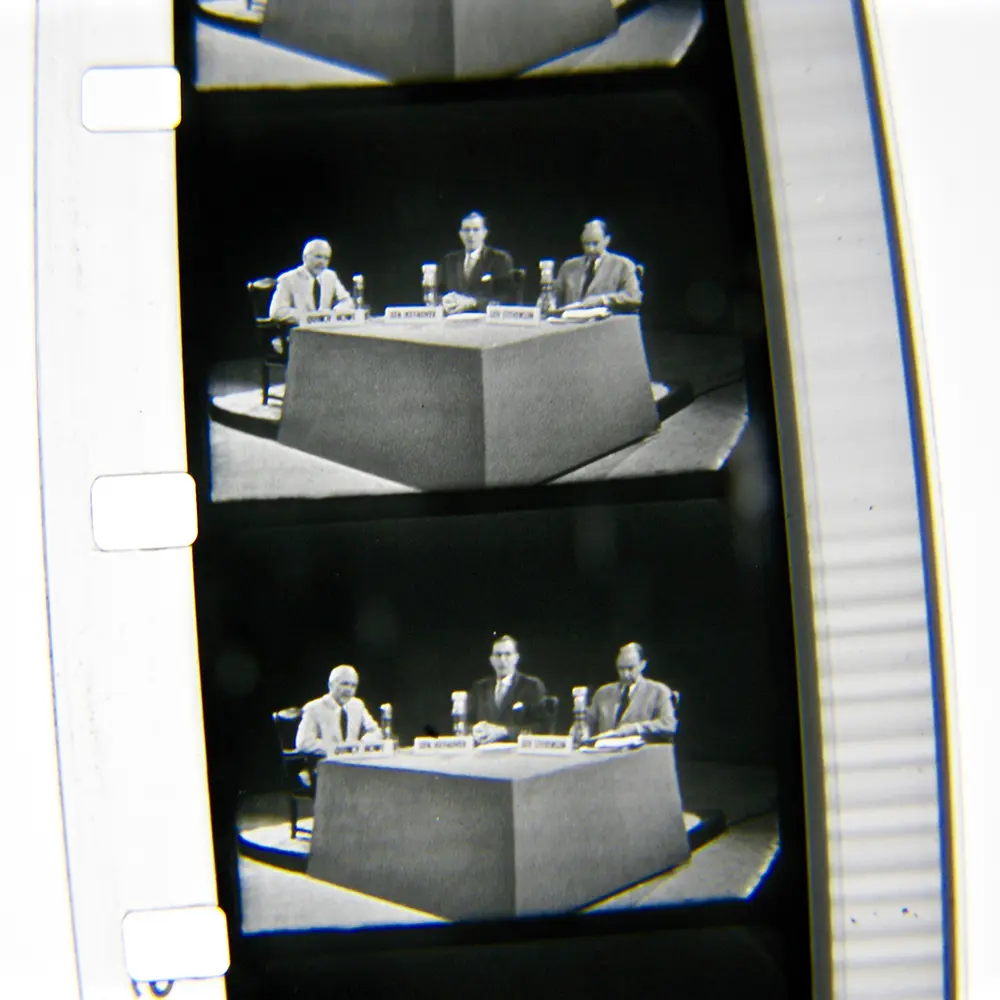
Estes Kefauver faces Adlai Stevenson in the first televised debate in a presidential race. It was during the 1956 Democratic primary.
That's unfortunate because democracy depends on something deeper than clever comebacks. It depends on citizens who are willing to think, question, listen, and occasionally admit they were wrong.
Maybe that's the lesson worth recovering from the long history of debate. The purpose was never simply to defeat an opponent. It was to sharpen ideas, expose weak reasoning, and move a community a little closer to the truth. We could use more of that today.
Loyd is director of the ALPLM's oral history program.
Legal Disclaimer:
EIN Presswire provides this news content "as is" without warranty of any kind. We do not accept any responsibility or liability for the accuracy, content, images, videos, licenses, completeness, legality, or reliability of the information contained in this article. If you have any complaints or copyright issues related to this article, kindly contact the author above.
