

Vehicle Barrier System Market to Surpass USD 36.1 Billion by 2036 as Modernization Drives Industry Replacement Cycle
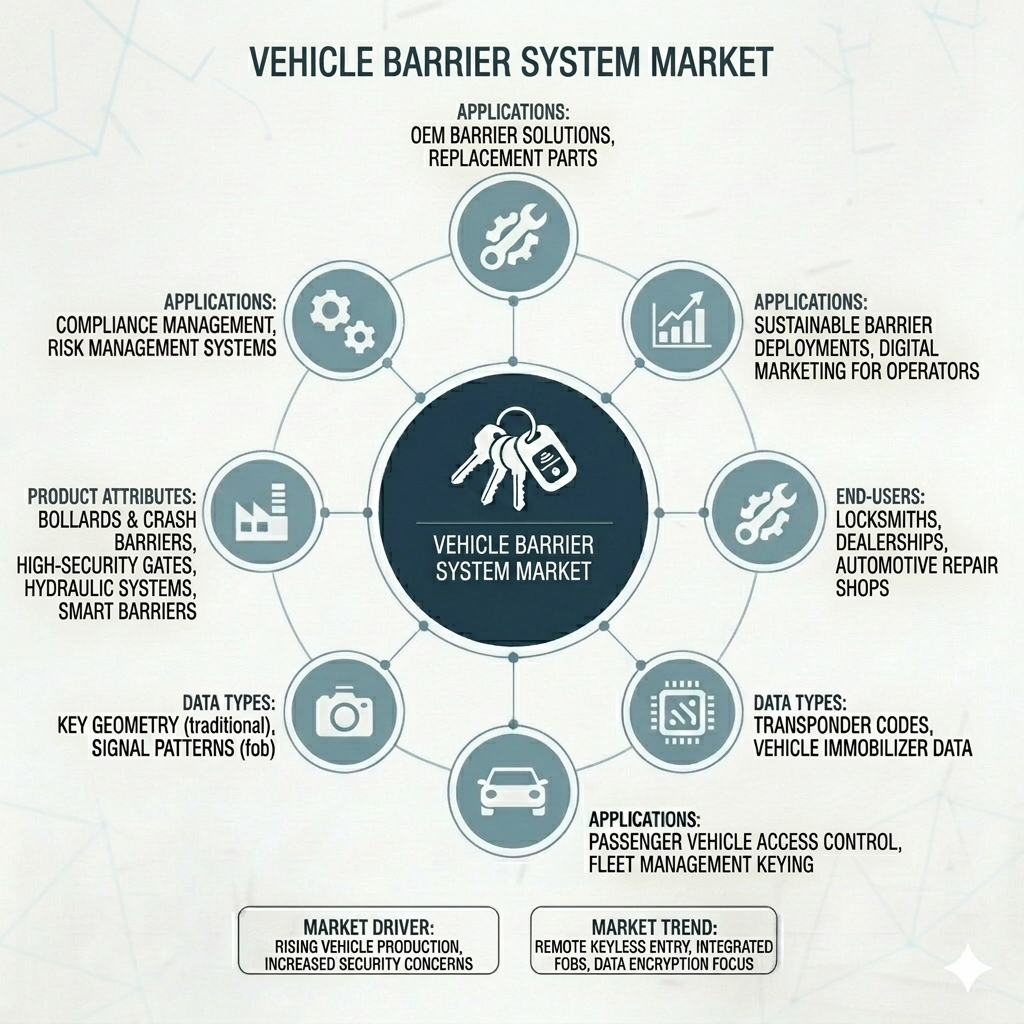
Vehicle Barrier System Market
Demand for perimeter hardening solutions is estimated to grow to USD 25.1 billion in 2026 and USD 36.1 billion by 2036.
NEWARK, DE, UNITED STATES, March 23, 2026 /EINPresswire.com/ -- The global landscape of physical security is transitioning from passive obstruction to a digitally integrated, "Compliance-First" capital expenditure cycle. According to the latest strategic analysis by Future Market Insights (FMI), the Global Vehicle Barrier System Market is valued at USD 25.1 billion in 2026 and is projected to reach USD 36.1 billion by 2036, expanding at a compound annual growth rate (CAGR) of 4.1%.
This market acceleration is increasingly decoupled from broader construction downturns, fueled instead by a "replacement super-cycle." Facility managers are moving away from legacy mechanical gates in favor of intelligent, crash-rated systems that satisfy rigorous new insurance mandates and government safety codes, such as the UK’s "Protect Duty" and updated U.S. Department of Homeland Security (DHS) strictures.
The "Smart Perimeter": Automation and Integration Lead Growth
The industry is seeing a fundamental shift in how barriers are procured and managed. Security is no longer a standalone silo but a critical endpoint in a connected digital network.
Get Access of Report Sample:
https://www.futuremarketinsights.com/reports/sample/rep-gb-5865
Key Market Takeaways for 2026:
• Automatic Systems Command 55.0% Share: Driven by labor shortages and the need for remote management, automatic barriers are now the industry standard for airports, logistics hubs, and government campuses.
• Bollards Hold 35.0% Market Share: Favored for their "invisible security" profile, bollards dominate urban centers and commercial plazas where aesthetic integration is as vital as stopping power.
• The Rise of Shallow-Mount Technology: Innovations like Gibraltar Perimeter Security’s recently patented G-1600 Series allow for crash-rated protection in utility-dense urban environments without the need for deep, disruptive excavation.
Strategic connectivity is also reshaping the market. Modern barriers are now expected to be compatible with vehicle security sensor grids, real-time stolen vehicle tracking systems, and cloud-based access models, turning physical gates into active data nodes.
Regional Engines: High-Volume Growth in Asia-Pacific vs. Modernization in the West
The global vehicle barrier system market is undergoing a transition toward integrated, high-security perimeters, with growth varying by regional infrastructure and regulatory priorities. China is projected to lead the market with a 5.5% CAGR, driven by a combination of aggressive national defense spending and stringent internal security mandates. In India, the market is expanding at a 5.0% CAGR, fueled by a massive urbanization wave and the continued rollout of the 100 Smart Cities Mission, which integrates surveillance-linked barriers into modern urban grids.
In Western markets, growth is characterized by the hardening of existing critical infrastructure. The United States is expected to see a 3.8% CAGR, supported by substantial federal security grants and a focus on protecting high-risk facilities. Germany follows with a 3.5% CAGR, where demand is anchored in high-tech industrial protection and rigorous municipal safety codes. Meanwhile, the United Kingdom is projected to grow at a 3.0% CAGR, as the sector stabilizes through post-attack regulatory reviews and a fleet-wide shift toward standardized PAS68 and IWA14 compliance for public spaces.
In India, the completion of nearly all Smart Cities Mission projects by May 2025 has established a vast network of surveillance-linked barriers. Over 84,000 CCTV cameras are now integrated with traffic enforcement points, creating a sustained demand for automated, sensor-compatible barrier hardware.
Competitive Landscape: Consolidation and "Made-In" Mandates
The competitive arena is defined by a shift toward localization. Major players are moving away from the "import model," instead establishing joint ventures to meet domestic manufacturing requirements in high-growth regions like the Middle East and South Asia.
• ASSA ABLOY: Strengthened its North American footprint in March 2025 through the acquisition of Wallace Perimeter Security, a move that allowed the global leader to consolidate its portfolio of high-margin commercial and residential gates.
• Gibraltar Perimeter Security: Recently partnered with NGMSA in Saudi Arabia (December 2024) to locally manufacture crash-certified products, directly aligning with Saudi Vision 2030 localization goals.
• Delta Scientific: Setting new benchmarks in deployment speed, Delta achieved an M30/P3 designation for its MP100 portable barrier, offering a high-security solution for temporary events that can be deployed without heavy construction equipment.
Leading Players in the Vehicle Barrier System Market:
• Avon Barrier (12.0%)
• Nice S.p.A.
• Came S.p.A.
• Magnetic Autocontrol
• Gunnebo Group
• Delta Scientific
• Gibraltar Perimeter Security
• Ameristar Perimeter Security
• Hormann Industries
Executive Summary: The Path to 2036
The next decade of perimeter security will be defined by the convergence of physical durability and cybersecurity. As Alejandro N. Mayorkas, Secretary of the U.S. DHS, noted, the commitment to national safety requires evolving resources to meet modern threats. For manufacturers, the path to market leadership lies in:
1. Barrier-as-a-Service (BaaS): Pivoting to recurring revenue models through cloud-integrated monitoring and maintenance.
2. V2X Cybersecurity: Protecting connected perimeters against remote tampering as barriers integrate with vehicle-to-everything communication protocols.
3. Aesthetic Hardening: Developing "street furniture" that provides M30-rated protection while blending seamlessly into the pedestrian landscape of modern smart cities.
Frequently Asked Questions (FAQ)
1. What is the difference between a standard gate and a "crash-rated" barrier?
A standard gate is designed for traffic control and organization. A crash-rated barrier (certified M30, M50, P1, etc.) is engineered and physically tested to stop a specific vehicle weight (e.g., 15,000 lbs) traveling at a specific speed (30-50 mph) with minimal penetration.
2. Why are "shallow-mount" bollards becoming more popular?
In old or dense cities, underground utilities like water, gas, and fiber optics make deep excavation impossible. Shallow-mount bollards require only a few inches of foundation, making them easier and cheaper to install in urban areas.
3. How does automation reduce costs for facility managers?
Automated systems eliminate the need for 24/7 manual guard presence at every entry point. Integrated with license plate recognition (ANPR) and remote cloud management, a single security team can manage dozens of gates from a central hub.
4. Is the market affected by the downturn in residential construction?
Very little. Most demand is driven by government mandates, defense budgets, and critical infrastructure (data centers, power plants, airports), which operate on independent, long-term funding cycles.
Brows More Industry Reports :
Barrier System Market
https://www.futuremarketinsights.com/reports/barrier-system-market
Vehicle Tracking System Market
https://www.futuremarketinsights.com/reports/vehicle-tracking-system-market
Vehicle Radar Test System Market
https://www.futuremarketinsights.com/reports/vehicle-radar-test-system-market
Sudip Saha
Future Market Insights Inc.
+1 347-918-3531
email us here
Legal Disclaimer:
EIN Presswire provides this news content "as is" without warranty of any kind. We do not accept any responsibility or liability for the accuracy, content, images, videos, licenses, completeness, legality, or reliability of the information contained in this article. If you have any complaints or copyright issues related to this article, kindly contact the author above.
